
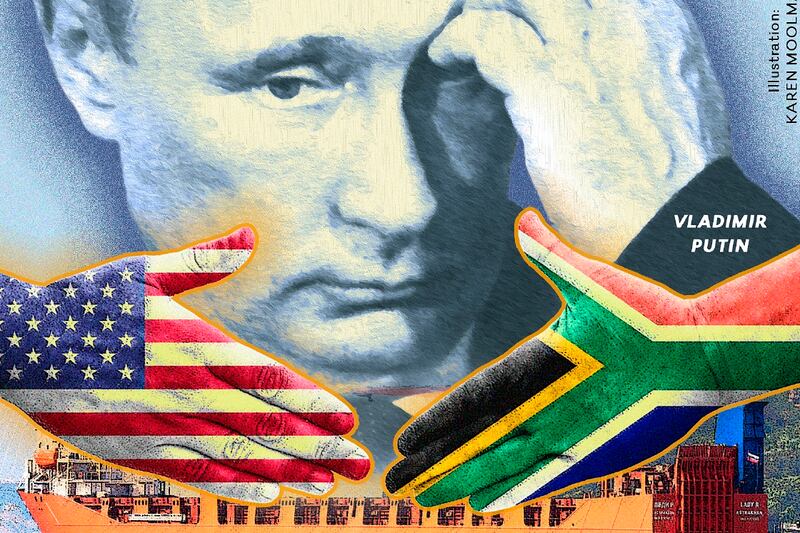
Russia’s prospects have declined since the late US senator John McCain asserted a decade ago that Russia is a petrol station masquerading as a country. Commodity exports fund the imperial ambitions of Russia’s president while discouraging integration into global supply chains.
ANC leaders prioritise party unity and use patronage to subdue tensions among factions. SA’s resource wealth helps fund patronage, which the ANC also leverages through identity politics to capture electoral support. Such political economics unleashed hostility towards competitiveness, encouraging localisation policies amid an intensely integrated global economy.
About a quarter of a million South Africans in their 20s become permanently marginalised each year. This affliction has now been festering for roughly two decades, and the pace will be no slower a decade from now, as our national dialogue lacks credible remedies for our 10-million-person unemployment queue.
Prospects for Russia’s 20-somethings are just as dismal despite low unemployment. Young Russian men who don’t emigrate risk dismemberment and death in Ukraine, and young Russian women have better job prospects while being less likely to marry.
McCain was implying that Russia doesn’t have a political economy that accommodates 21st-century global realities. The same can be said of SA. Both SA and Russian leaders dismiss the reality that the primary drivers of economic growth today are services, disruptive technologies and global integration. Young Russians and South Africans who can compete globally are encouraged to emigrate.
Consequences of the ANC’s economic and international relations stewardship include entrenching the world’s most severe youth unemployment crisis and aligning with Russia, Iran and Hamas. As few of today’s successful economies have the option of exporting commodities to fund their imports, they focus on achieving high competitiveness through carving out niches in global supply chains. Russia and SA ignore how this has become necessary to sustain much-needed high growth and productivity gains.
In a nutshell, both countries are wildly out of sync with prevailing economic and geopolitical norms — and basic common sense. Russia is by far the largest country geographically, yet it sacrifices its youth, and thus its future prospects, through its pursuit of territorial gains, which trigger unaffordable isolation.
Many, perhaps a majority, of SA school leavers will confront permanent marginalisation, and this reflects how vanishingly few of our young adults add value to exports. Maintaining localisation policies despite extreme unemployment cripples growth and job creation. High government and household indebtedness block prospects for a commodity boom to unleash virtuous cycles.
Since Nelson Mandela began his prisoner-to-president transformation the ANC has parlayed a global perception of high moral authority into support for Hamas amid little regard for the majority of today’s South Africans, who are unemployed, destitute or both.
Meanwhile, global poverty has plummeted, reflecting humanity’s most remarkable accomplishment: the spectacular and spectacularly rapid rise of Asia. While our policymakers and public intellectuals remain uninterested in how this was accomplished, the ANC’s antipathy towards the West, and its anticompetitive policies, dissuade our companies from carving out niches within global supply chains.
Like Russia’s leaders we presume isolation is a viable option. But the ANC’s localisation policies not only can’t correct the unemployment crisis, they greatly exacerbate it. Both SA’s and Russia’s leaders reject following today’s proven path to achieve broad prosperity: intensely integrating into the global economy through specialisation.
It is a profound error to think we must identify segments where we can successfully compete before abandoning our localisation-focused policies and mindset. The evidence is overwhelming that they must be abandoned in favour of supporting value-added exporting. Identifying specialised segments where we can compete then becomes a separate and ongoing exercise.
By far the least politically demanding and most economically promising policy pivot would be providing sweeping exemptions from anticompetitive regulations for all new value-adding export initiatives. This would cost nearly nothing while heralding a new beginning.
ANC leaders would be wise to break the isolationist mindset they share with their Russian comrades and embrace such economically liberating thinking.
• Hagedorn (@shawnhagedorn) is an independent strategy adviser.





Would you like to comment on this article?
Sign up (it's quick and free) or sign in now.
Please read our Comment Policy before commenting.