
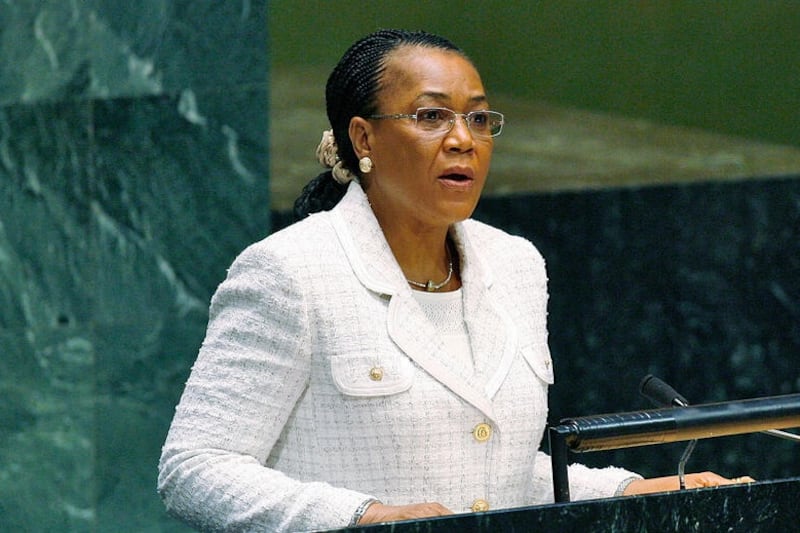
Joy Uche Ogwu, Nigeria’s most prominent female scholar-diplomat, died in New York at the age of 79. In a deeply patriarchal, male-chauvinist Nigerian society in which women are often marginalised in political and diplomatic life, she was the ideal role model for many aspiring girls seeking a career in public service.
Ogwu was the first female director-general of the prestigious Nigerian Institute of International Affairs (NIIA) between 2001 and 2006, the second female foreign minister (August 2006-May 2007) after Ngozi Okonjo-Iweala’s brief two-month stint in the post, and the country’s first female permanent representative to the UN between 2008 and 2017.
‘Deep faith, moral roots’
She was widely regarded as humble, charming, calm, self-effacing, soft-spoken, smart, stylish and strikingly beautiful. Matthew Kukah, the Catholic bishop of Sokoto, described her as “a devout Catholic of deep faith and moral roots”. Harald Braun, Germany’s former ambassador to the UN, noted that “she was a kind and caring human being, always remembered all around the globe by this unique combination of superb qualities”.
Ogwu obtained her bachelor’s and master’s degrees in political science at Rutgers University, New Jersey, in the US, before completing her doctorate in the same subject at the University of Lagos in 1977. She then joined the NIIA, where she would spend the next three decades at Nigeria’s premier foreign policy think-tank.
She foresightedly focused particularly on three issues that were not considered mainstream at the time: Nigeria’s role in South-South relations, charting alternative futures for Nigeria’s foreign policy and disarmament.
Ogwu was the most dynamic and accessible of the six NIIA directors-general I encountered. She sought to restore the institute to its former glory, re-establishing its policy influence and convening lively, high-profile seminars at which she was always present as the quietly exuberant hostess.
She brought back the diplomatic and academic community and published long-delayed journals, books and lecture series. She renovated and painted dilapidated buildings and seminar rooms, and restocked its first-rate library.
During her decade as Nigeria’s ambassador to the UN, the widely respected Ogwu served on the UN Security Council, chaired the UN Special Committee on Peacekeeping Operations, was the pioneering president of the executive board of UN Women, and chaired the board of the UN Institute for Disarmament Research.
As chair of the UN Special Committee on Peacekeeping Operations, she consistently pushed for greater support for peacekeeping missions in Africa, as well as more effective co-ordination between the UN and African regional organisations.
On the UN Security Council she used her unprecedented two stints in 2010/11 and 2014/15 to focus on women, peace and security; security sector reform; and global conflicts, working closely with civil society. She was particularly pained by two votes on the council: a positive one on Libya in 2011 that facilitated the disastrous Nato intervention, and an abstention in 2014 on a resolution calling for the withdrawal of Israel from the West Bank and the establishment of a Palestinian state. She later bemoaned the lack of foresight and direction from Abuja and other African capitals.
As chair of the UN Special Committee on Peacekeeping Operations, she consistently pushed for greater support for peacekeeping missions in Africa, as well as more effective co-ordination between the UN and African regional organisations. She called for more predictable funding and logistical support to back these efforts and was particularly committed to human security and the protection of civilians, advocating “robust” peace-enforcement to achieve these goals.
She consistently condemned gender-based violence and promoted the empowerment of women, noting: “Women everywhere continue to face major challenges in accessing and, indeed, enjoying their human rights despite years and decades of efforts.”
One of Nigeria’s most distinguished public servants and a devoted mother of five children, Ogwu was honoured with Nigeria’s Order of the Federal Republic in 2004.
• Adebajo is professor and senior research fellow at the University of Pretoria’s Centre for the Advancement of Scholarship.




Would you like to comment on this article?
Sign up (it's quick and free) or sign in now.
Please read our Comment Policy before commenting.