
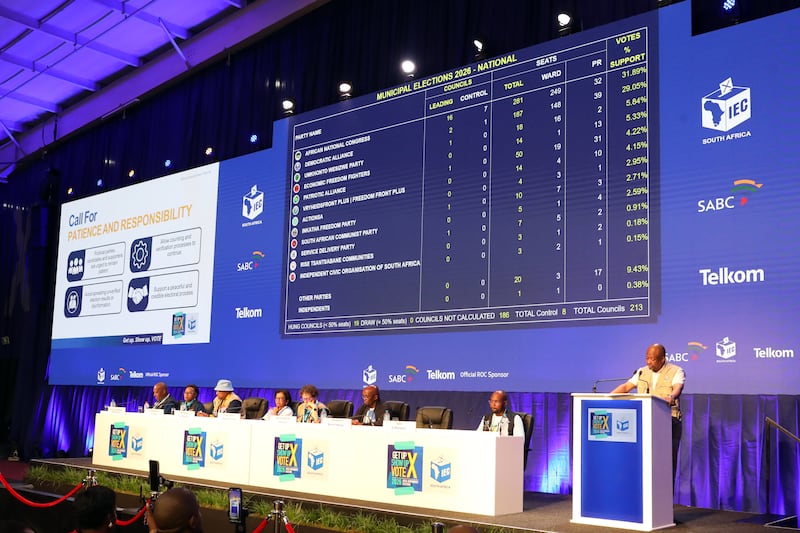
The rapid decline of the once-dominant ANC creates both opportunity and uncertainty. The opportunity is for other parties to win its voters and occupy the political vacuum its descent creates. The uncertainty is caused by the fact that the ANC is not being replaced by any one new dominant party. Instead, there is fragmentation.
Hence, the 2026 local government election (LGE) will be defined not by who “wins” ― since there will be a precious few outright winners, certainly in the bigger metropolitan areas – but by what emerges from the no-doubt fraught 14-day period of negotiation that will commence on Monday after the declaration of the results on Sunday.
Accordingly, a party such as the DA may win at the ballot box but lose at the negotiating table.
Pretty much everyone in politics agrees that the legally prescribed 14-day window is far too tight. But, because of other more contentious issues ― such as thresholds for representation ― it was not possible to pass legislation in time for yesterday’s election.
The pressure on the negotiating teams of the various protagonists will be intense ― even more so than in the fetid weeks after the 2024 national and provincial election since this time there are so many more governments to form and, therefore, so many more deals to be done.
At a time of exhaustion after weeks of intense campaigning, those leaders will have to maintain their composure and their clarity of mind about what constitutes a reasonable redline issue upon which to found their negotiating tactics.
They will have to constantly remind themselves to keep their eye on the ball and to ask themselves the right overarching question, which is not “who do I like or dislike?” or “who would I prefer to get into bed with?” but rather, “who will provide me with the most stable and reliable partner in government?”
This will require both focus and a recognition that South Africa’s electorate appears to have voted for change. Not only is turnout up on the last LGE in 2021, but the apparent shift in support between parties ― and especially away from the ANC ― indicates that residents want different and better municipal governments.

This is not surprising at all given the parlous state of local governance across South Africa, meaning, in turn, that the exam question for this election is “will coalition governments be formed that are sufficiently stable to have a chance at executing a turnaround?”
The greater fragmentation means that there will be more kingmakers or wannabe kingmakers in the mix. Bigger parties will be understandably wary of them. The experience of the past decade shows that too often the tiny tail has wagged the bigger dogs and not to the benefit of residents and businesses.
Those trying to run businesses in Nelson Mandela Bay, for instance, have been pulling their hair out for much of the past decade since the ANC first lost its majority at the 2016 LGE. They yearn for stability and for a reliable government to engage with. Again, however, the electorate has opted against giving any party a majority in the City Hall and a new cycle of stalemate beckons.
Unless, that is, the grand coalition that lies at the heart of the government of national unity (GNU) ― the alliance between the ANC and the DA, adorned admittedly with a sprinkling of smaller parties ― can be transposed to the local government sphere. A government of local unity could be the answer or at the start of providing the answer that citizens and the economy need. But this will require the same kind of leadership that was shown in 2024 ― to overcome historical and personality-based differences, which tend to be even more pronounced at provincial and local level ― to put the country first. Whether the ANC’s national leadership is willing to exert such a mature approach when it will be once again having to digest another major electoral setback is another question altogether.
- Calland is visiting adjunct professor at the WITS School of Governance and Partner of the Paternoster Group, which has established a City Risk Monitor that roots its political analysis of the LGE in the economic risk profile of municipalities in South Africa



Would you like to comment on this article?
Sign up (it's quick and free) or sign in now.
Please read our Comment Policy before commenting.