
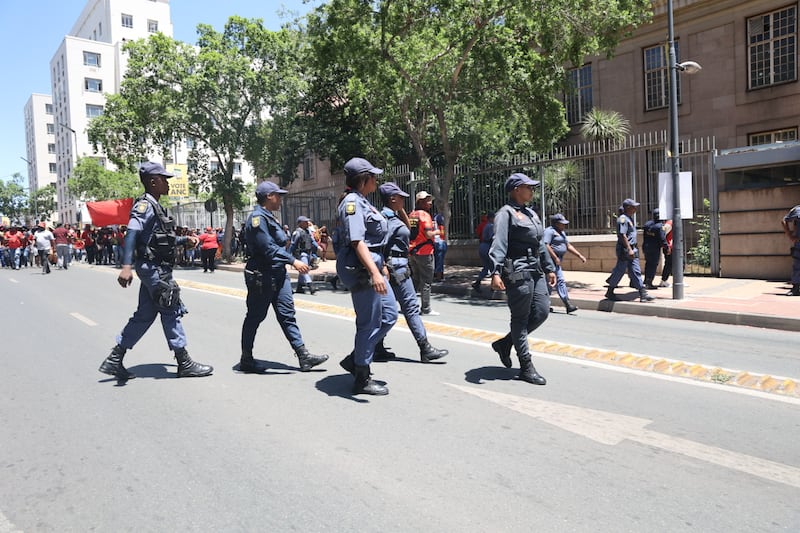
Tara Roos’s recent column correctly identified crime as Cape Town’s Achilles’ heel (“Cape Town is a crime scene, not a utopia”, October 30). However, the inequality of crime exposure is matched by an inequality of policing that falls squarely in the control of the South African Police Service (SAPS), and the province and city have attempted to fix that for more than a decade.
As Western Cape premier, in 2012 Helen Zille utilised the extremely limited oversight powers available to a province to institute a commission of inquiry, colloquially termed the Khayelitsha commission, into policing in the Khayelitsha area. This was strongly resisted by the SAPS and only commenced after litigation.
During the commission witness after witness referred to a lack of human resources for policing. The commissioners, Vusi Pikoli and Kate O’Regan, wanted to understand whether this lack was evident everywhere, or whether it was particular to the Khayelitsha area. To this end, allocations of officers to police station level in the Western Cape were made available to the commission.
Analysis of these allocations revealed township and Cape Flats areas had far lower per capita allocations of officers than other police stations in the province. Harare, one of three police stations in Khayelitsha, had the lowest per capita allocation of all. This meant an inverse relationship was found between murder rates and policing rates — areas with higher murder rates had lower policing rates. How is this possible?
This is the result of the formula employed by the SAPS to determine the theoretical allocations to police stations, which used reported crime figures and a range of weighting factors.
The problem with this approach is rates of reporting of crime vary considerably: surveys commissioned by the provincial government found affluent suburban areas had high rates of reporting crime, in the region of 70%, while more deprived areas had low rates (about 25%).
Furthermore, the weighting factors more likely found in suburban areas outnumbered factors more likely found in township areas by two to one. Thus, the formula by design decided suburban areas needed more per capita policing than township areas.
On average, police stations were allocated 67% of the theoretical, with some priority stations — those with the highest number, not rate, of murders — allocated 100%. Despite this, the outcome was still that poorer, township areas with high murder rates were given the lowest allocations. Calculations suggested upward adjustments would need to be in the 100s of police officers to bring these areas in line with other areas.
The commission recommended the SAPS change its allocation process. Three years passed and little changed. Then the Social Justice Coalition, Equal Education and the Nyanga Community Police Forum took the SAPS to the Equality Court, and won. The SAPS was ordered to consult and adapt its formula.
Despite this, adjustments in allocations have not been of the scale necessary. This would almost certainly require the establishment of additional police stations as the worst areas, such as Nyanga and Mitchells Plain, also serve large populations numbering in the hundreds of thousands.
During this protracted legal process Alan Winde became premier of the province in 2019, after a short stint as community safety MEC. Winde set the province a target of halving the murder rate by 2030. While a comprehensive set of crime prevention interventions in schools and communities falls more easily into the provincial ambit, Winde recognised additional policing would need to be part of the package.
As the SAPS failed to make the necessary adjustments, and the province had no direct powers of policing, he sought to bolster policing via municipal law enforcement. National legislation outlaws the external funding of municipal metro police, but no such limitation applies to law enforcement exercised as an incidental function of the municipal power to make by-laws.
The provincial Law Enforcement Advancement Programme (Leap) was established in 2019, with the province funding the training and deployment of an additional 1,000 law enforcement officers in Cape Town, exclusively in high murder rate areas. Law enforcement training in other municipalities has also been funded.
Though they have limited powers compared to SAPS and metro police, Leap officers provide visible policing and regularly confiscate illegal firearms and dangerous weapons. Unfortunately, single digit conviction rates for unlawful possession of firearms in places such as Athlone, Nyanga, Khayelitsha and Grabouw — all high murder rate areas — are evident; all such cases are processed by the SAPS and National Prosecuting Authority.
In addition, much to the dismay of the city, the courts have been treating firearm offences lightly: the Athlone court recently granted R5,000 bail for those arrested by metro police for unlawful possession of AK47s, and sentences seldom involve imprisonment.
Deployment of Leap officers works best when there is good co-operation with the SAPS, which has extensive powers. Initially this was not forthcoming, but both recent government of national unity (GNU) police ministers, Senzo Mchunu and Firoz Cachalia, have encouraged greater co-operation.
Furthermore, since April 2026 Operation Prosper has seen the deployment of military personnel to further bolster numbers in high murder areas. A recent double murder in Military Road near Lavender Hill saw a response within minutes and the suspects arrested, with all these agencies co-operating.
The data from Western Cape forensic pathology, which records weekly homicides, is unequivocal that most Leap and Operation Prosper areas are so far showing a reduction in the number of homicides compared to equivalent periods of earlier years. Whether that is attributable to their presence or other factors is, of course, not known. However, as we are in the part of the year where murders usually rise, the lived experience of people right now would not reflect that change, and murder and violence remain unacceptably high.
What of Winde’s goal to halve the murder rate? In the Western Cape, using SAPS figures for July to June 2018/19, the murder rate was 71 per 100,000. For July to June 2025/2026, it was 57 per 100,000. This is a 20% reduction since 2018/19. This was not only a result of population growth, but also due to an actual reduction in the number of murders.
The murder trends since 2019 have been dramatic. Lockdown saw an unnatural decrease, followed by a soaring increase thereafter across South Africa, a trend that only began to temper from mid-2024. The Western Cape had a more muted increase.
Though the country has seen a recent reduction in murder numbers, the number is still larger than that recorded in 2019. Nevertheless, the equivalent murder rate calculations for South Africa excluding the Western Cape show the murder rate going from 34 per 100,000 to 33 per 100,000.
Thus, though the murder rate of the Western Cape remains extremely high and higher than the rest of the country, progress has been made in bringing it down. For the rest of the country, after increases and decreases, it is pretty much where it was in 2018/19.
For further reductions to occur in the Western Cape policing must on a permanent basis recognise the Cape Flats needs more, not only equal policing. Whether that involves fixing the SAPS and its allocation system, or increasing the powers of sub-national policing (“devolution”) is a debate that will continue.
The prosecuting authorities and the courts will have to step up too — single digit firearms conviction rates and a lax approach to automatic weapons possession are unacceptable. Non-policing interventions — the whole of society approach that has accompanied the reductions thus far — must be maintained and extended.
South Africa as a whole managed to halve the murder rate between the late 1990s and 2010. It can be done again, but it requires the co-operation of all levels and functions of government. This seems to have become more possible since the advent of the GNU.
- Redpath is a senior researcher at the Dullah Omar Institute. She provided expert evidence to the Khayelitsha Commission and in SJC v Minister of Police. She serves on the provincial safety advisory committee of the Western Cape.
Business Day



Would you like to comment on this article?
Sign up (it's quick and free) or sign in now.
Please read our Comment Policy before commenting.