
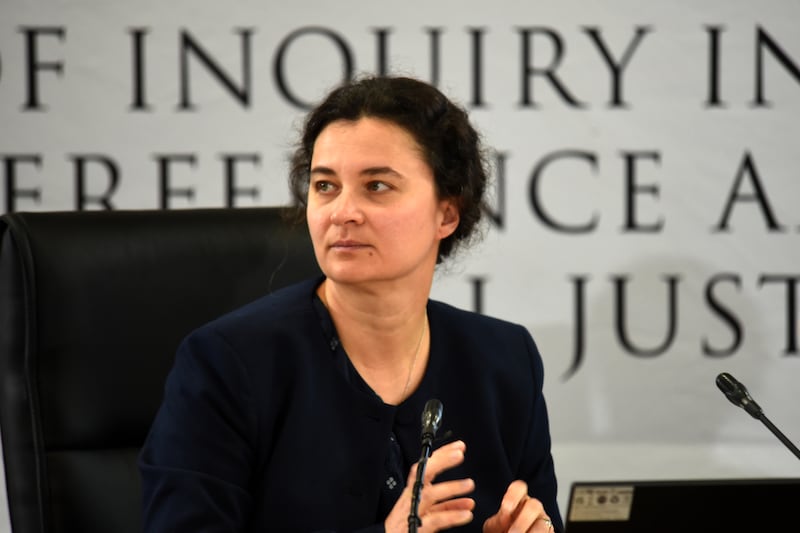
Senior criminal justice officials and their family members should undergo financial vetting, and those who have accumulated wealth unlawfully should be fired and banned from working for the state, World Bank official Laura Pop told the Madlanga commission on Wednesday.
Pop, a World Bank senior financial sector specialist, is an expert on money-laundering.
The commission of inquiry is investigating allegations of criminal infiltration into the country’s law enforcement agencies and its criminal justice system.
Her evidence centres on what the commission could consider before making its recommendations to President Cyril Ramaphosa.
Pop leads anticorruption, anti-money-laundering and asset recovery programmes in Southern Africa, South Asia and Eastern Europe. She also leads research projects on anticorruption issues, in particular financial disclosure systems for public officials.
Drawing from countries which have experienced justice system capture, Pop said some countries took extraordinary measures to reset the justice system.
One that South Africa could consider is a body that assesses financial records of senior officials in compromised institutions and their close persons’ assets, expenditures, and declared income.
“Several countries have come to the conclusion that new extraordinary mechanisms are needed to rebuild trust in institutions and remove compromised individuals quickly and at scale,” Pop said.
In South Africa, the government tends to be criticised for acting slowly against corruption-accused officials.
Amid allegations of corruption before the commission, the police have fired crime intelligence top cop Maj-Gen Feroz Khan; Maj-Gen Richard Shibiri, the former component head of organised crime; and Brig Rachel Matjeng, linked to corruption accused Vusimusi Matlala.
Many police officers implicated in corruption, including police deputy commissioner Lt-Gen Shadrack Sibiya, are still employed in public service.
Pop said those found to have accumulated wealth unlawfully in the financial analysis could be removed from the criminal justice institution and banned from working for the government.
“A time-limited bar on re-employment in the same institution and in related bodies should attach to removal and to any resignation tendered to avoid the process so that those removed do not resurface in adjacent institutions,” Pop said.
She added that while a government undertakes extraordinary measures to clean up a system, it should consider the legal rights of the officials.
She said the duration of the ban varies for different countries, but it could be about 10 years. If the commission adopts this in its recommendations, it could determine the number of years rogue officials would be banned from working for the state.
Establishing a body for analysing financial records of officials as a method to clean up the justice system has resulted in the most removals in various countries, Pop said.
The body to conduct such financial analysis should have legal authority to access property, banking, tax and other records — not only of officials but also their families.
“The evaluation body makes its conclusion based on an ad hoc comprehensive declaration by the officer covering assets, expenses, income and liabilities of the officer and family members, verification against official property, company, vehicle, banking, tax and other records, and any lifestyle audit that it may have commissioned,” she said.
Lying on the employer’s declaration form for the financial analysis is a ground for removal, she said.
“The untruthfulness or incompleteness of the declaration is itself an independent ground for an adverse finding,” she said.
“The legal instrument should require every officer subject to the evaluation to submit an ad hoc electronic declaration covering the period fixed by legislation and the assets, income, expenses, liabilities and other interests of the officer and family members.
Pop said failure to submit the declaration could be treated as a refusal to undergo evaluation and a ground for automatic termination of office.
The commission had a similar case of nondisclosure in analysing dismissed crime intelligence boss Khan’s disclosure documents.
The commission’s investigations found Khan owned several businesses but did not fully disclose his business interests to the SAPS for years.

The state could provide an option to officials to resign before conducting a thorough financial audit. Pop said other countries implemented it to create leeway for possibly tainted officials to leave the service without a costly investigation.
The choice to jump before the audit, however, comes with a regulatory ban on working in the public service for a specified period. If the commission were to adopt this approach, it would have to consider how long that period should be.
“The officer who does not resign (retire) within the set window is then required to undergo the evaluation. Refusal to undergo the evaluation, or failure to submit an ad hoc asset declaration, triggers the officer’s dismissal,” she said.
Pop said persons removed with an adverse finding or who resigned in advance could be included in a central register to ensure they are not employed by the state before the ban lapses.
She said maintaining the integrity of the institutions and preventing their reinfiltration, however, would require longer-term reforms to address ordinary preventative and integrity management measures.
These include addressing vulnerabilities in the financial disclosure framework, introducing civil forfeiture for unjustified variations of wealth, strengthening appointment processes for senior officials and officials in high-risk positions, and enhancing oversight by independent mechanisms.
Business Day






Would you like to comment on this article?
Sign up (it's quick and free) or sign in now.
Please read our Comment Policy before commenting.