
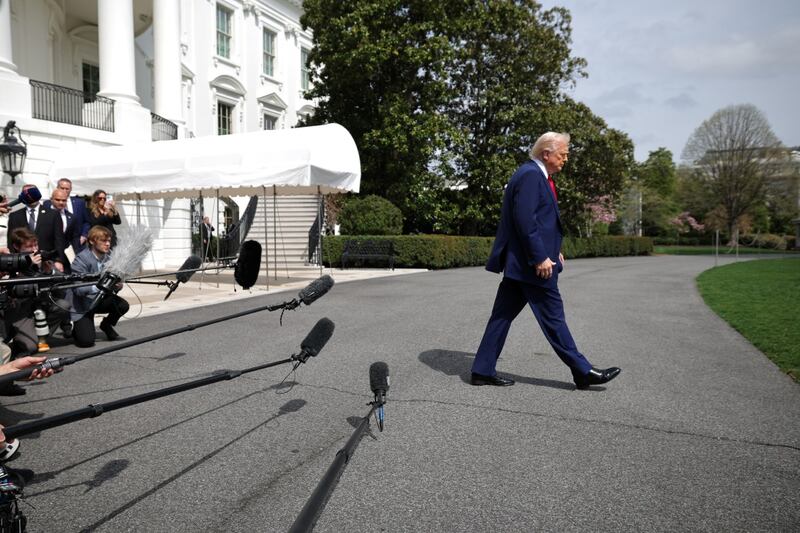
I don’t know if you’ve noticed, but things have gotten pretty weird in the good ol’ US of A. Even in comparison to Donald Trump’s decidedly weird (to say the least) first term, his second go as “Potus” has been even more unhinged.
And eventful. Believe it or not, Trump has not, in fact, been in office for a decade. Apparently, and I had to check this, he hasn’t even been in office for a full year yet.
But just look at what has happened on his watch in less than 12 months. Tariffs, the Epstein files, military deployments in US cities, calling a female reporter “Piggy”, siding with Vladimir Putin over Ukraine, revoking tariffs, siding with Benjamin Netanyahu, turning on Netanyahu, siding with Netanyahu again, furthering the Abraham Accords, going to war with late night comedians, revoking tariffs, denying the Epstein tapes, standing up against antisemitism, sort of turning against Putin, standing with antisemites, cancelling tariffs, calling for the release of the Epstein files, throwing his full support behind Putin again, re-instating tariffs, lying repeatedly about the economy, calling Saudi Arabia’s murder and dismemberment of a journalist something “that happens”, boasting about having the greatest MRI results ever, using the justice department to go after political enemies, blaming Democrats for the Epstein files.
Never mind the past year, much of this was just in the past month! Say what you want about him, but you certainly can’t call “The Donald” dull.
But what’s perhaps more interesting is the way culture and politics have warped around him. For now, most of these effects have stayed with America, but as the saying goes — and the reason I’m writing about this for a South African publication — “when America sneezes, the world catches a cold”.
Trump’s New America
Simply put, across one-and-a-quarter terms Trump has completely upended the US political system that has been in place since the Second World 2.
First, and this has been the case since he won the nomination on his first go around, he reformed most of the Republican Party into Maga loyalists, leaving those few who didn’t play ball out in the cold. He’s less the leader of the Republican Party than its Dear Leader.
Second, he has caused a major fissure within the Democratic Party as the centre-left establishment finds itself challenged by the far-left populists that have always existed on the fringes but have now been energised by Trump’s own extremist rhetoric. This was true in his first terms, and even more true now.
Not to be outdone, even the Maga Republicans are now at war with one another over the Epstein files and, of all things, antisemitism and/or anti-Zionism. The latter of which, of course, also lies at the heart of the split between classic, centre-left democrats and the new wave of hard-left populists.
Yes, there’s more to it than that, of course, as the sort of moderate social democracy that has traditionally been at the heart of the Democratic platform — one that tries to balance the ill effects of capitalism with numerous social programmes — is currently caught in a fierce battle against the far more revolutionary ethos of democratic socialism.
It’s a battle that was all but inevitable, as social democracy has failed to rein in the worst excesses of capitalism in the US and establishment Democrats simply haven’t inspired much confidence since Barack Obama left office.
But it says something that this split almost exactly mirrors the split in the American left’s attitudes towards Zionism and Zionist (read: most) Jews.
A rift between allies
Support for Israel was, until very recently, a bipartisan issue, as pro-Israel sentiment ran just as deeply among Democrats as it did Republicans. Things undoubtedly started to sour during Barack Obama’s two terms in the Oval Office, as he clearly had a fractious relationship with Netanyahu, but the Obama administration was still overwhelmingly pro-Israel.
The same was largely true of the Biden White House, which was both supportive of Israel, especially after Hamas’ attack on October 7 2023, and increasingly exasperated with Netanyahu and his far-right government.
But whatever was going on politically, there was an undercurrent of anti-Israel sentiment that started to take hold of the left — which exploded in the immediate aftermath of October 7. Part of this is the inevitable result of the liberalism that once defined the West being undermined by a neo-Marxist, anti-Western, identity-obsessed ideology (or “wokeness”, as it is unhelpfully known) that has presented itself as “progressive” but is really anything but.
Rather than being an outpost of multicultural liberal democracy in the anti-democratic Middle East, Israel suddenly became the final outpost of Western imperialism. “Progressivism”? This is little more than classic Soviet propaganda in a shiny new coat.
Some of this also comes down to pure antisemitism, of course, but the separation between left-wing anti-Zionism and antisemitism remains fairly complex. And yet it’s notable that while establishment Democrats have little problem calling out left-wing antisemitism, those on the hard left either refuse to call it out when it comes from their own ranks or are active participants in it.
The horseshoe theory
It says something too that despite emphatically disagreeing with far-right figures like Tucker Carlson or Candace Owens on every other issue under the sun, far-left populists such as New York’s mayor-elect, Zohran Mamdani, somehow manage to find plenty of common ground in their anti-Zionism — not least by using it as an excuse to platform blatant antisemitism.

While Carlson and Owens amplify the conspiracy theories and outright bigotry of neo-Nazis like Nick Fuentes, Mamdani has steadfastly refused to condemn the use of the genocidal cry of “globalise the Intifada” by his supporters and has known associations with Islamist fundamentalists, like one of the planners of the 1993 bombing of the World Trade Centre.
This is known as the horseshoe theory, so named for the way the poles of the far left and the far right start bending towards one another (forming a horseshoe shape — or a magnet, for that matter) when it comes to antisemitism.
The question when it comes to Mamdani is whether any of this has any relevance to his new job as the mayor of New York. When it comes down to it, does it actually matter what Mamdani’s thoughts are about Israel — even if he is against its very existence, as self-identified anti-Zionists are by definition? As mayor of New York, doesn’t it only matter what his policies are on a local level? Especially when he has as many Jewish supporters as he apparently does?

I’ve asked this exact question of Helen Zille during her run for mayor of Johannesburg. In response to a question on whether what was happening in Gaza was a “genocide”, she emphatically concluded that it was entirely irrelevant.
There’s a big difference here, though. Or, more specifically, two major differences. First, and most simply, people who believe Israel is guilty of genocide were and are in no danger of being attacked on the streets of Joburg, but anti-Zionism has been used as an excuse to attack Jews in America — up to and including their cold-blooded murder. This is especially relevant for what is, after all, the second most Jewish city on Earth (with a Jewish population second only to Jerusalem).
Indeed, only a few weeks ago anti-Israel protesters harassed and verbally abused Jews who were attending an “aliyah expo” — a talk about the ins and outs of immigrating to Israel — in one of New York’s oldest Orthodox synagogues. The irony here being especially poignant as one of the big reasons many American Jews might want to immigrate to Israel in the first place is because of such antisemitic displays.
Mamdani’s response was telling, as he mildly condemned some of the language these protesters used and asserted the rights of New Yorkers to attend their places of worship, before lambasting the synagogue and justifying the protesters by condemning the use of a “sacred space” for the “violation of international law”.
This is precisely why Mamdani’s views on Israel directly affect New Yorkers, especially Jewish New Yorkers. Telling Jews that they are only worthy of protection if they’re “good Jews” who separate themselves entirely from Israel — up to and including, apparently, considering escaping from New York to Tel Aviv because of rising antisemitism.
The canary in the coal mine
But there is something more fundamental going on here. As the late and very wise Rabbi Jonathan Sacks once put it: “The hate that starts with the Jews, does not end with the Jews.” Or, to quote a cliché, antisemitism is the canary in the coal mine: hatred of Jews has always, without fail, signified a civilisation facing its own destruction. Simply, a civilisation that is no longer working as it should looks very quickly for a scapegoat on which to blame its failings — and Jews have always served as that eternal scapegoat.
We in South Africa, Jew and non-Jew, living thousands of miles from the heart of the West with a political system very different from its US counterpart, should be very, very afraid if this is true. America is far from perfect, to put it mildly, but the ideals on which it is based are as close to perfect as any superpower has ever come. Which is certainly not something you can say about the countries waiting in the wings for their chance in the spotlight.
To go back to that infamous metaphor, America currently has only the sniffles, but sniffles can so quickly turn into something far, far worse. Let’s hope and pray that in this case they don’t.
• Preskovsky is a freelance writer.





Would you like to comment on this article?
Sign up (it's quick and free) or sign in now.
Please read our Comment Policy before commenting.