

When mobs attack African foreign nationals, looting or burning their shops and sometimes killing them, the instinct is to reach for a single explanation: desperate people lashing out. But that instinct mistakes the fuel for the spark. These episodes fit squarely into a more precise framework: the analysis of collective violence developed by American historical sociologist Charles Tilly in his 2003 book The Politics of Collective Violence.
Tilly defines collective violence as episodic social interaction that immediately inflicts physical damage on persons or objects, involves at least two perpetrators and results at least in part from co-ordination among those who carry out the damage. South African xenophobic attacks (the major waves in 2008, 2015, 2019 and smaller flare-ups ever since) match this definition precisely.
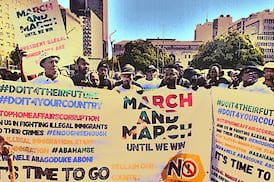
They are not random individual crimes but co-ordinated mob actions in townships. They are often triggered by rumours, service delivery protests or political rhetoric, with perpetrators shielded by community silence or complicity. Just recently, protests inspired by the group March and March turned violent in Mossel Bay, forcing people from their homes, burning houses and looting immigrant-owned shops; at least two men from Mozambique were killed.
If you have ever explained xenophobic violence by saying, “South Africans are poor and unemployed, so they turn on foreigners” you have been invoking, perhaps without knowing it, Ted Robert Gurr’s relative deprivation thesis — a theory once widely cited to explain exactly such outbreaks.
In his influential 1970 book Why Men Rebel the political psychologist argued that collective violence erupts when people experience a widening gap between what they expect (jobs, services and living standards) and what they actually get. The greater the perceived deprivation, Gurr believed, the greater the likelihood of rebellion or riot.
But it turns out that this common-sense theory does not survive scrutiny. Further research has shown that relative deprivation on its own does not explain most collective violence. In a landmark 1996 article in the Journal of Conflict Resolution physicist and science historian Stephen G Brush examined the rise and fall of Gurr’s theory, showing that his framework did not hold up under empirical testing.
Political scientist Edward N Muller’s 1972 study of racial disturbances in Waterloo, Iowa, found that relative deprivation was a weak predictor once other factors were considered. Muller discovered that the potential for violence depended far more on a low degree of trust in political authorities, combined with the belief that violence had worked for dissidents in the past. When those variables were controlled for, relative deprivation “does not seem to matter”.
Muller discovered that the potential for violence depended far more on a low degree of trust in political authorities, combined with the belief that violence had worked for dissidents in the past.
In South Africa the same two variables are visible. Xenophobic violence flares if citizens do not trust the authorities to address what they perceive as the source of their deprivation (competition from foreigners for scarce jobs, housing and services) and if the belief has taken hold that mob action gets results. The state’s own failures have entrenched both.
Poverty, unemployment and inequality are undeniably severe. These are conditions that generate real deprivation, not merely the perception of it. Yet most desperately poor South Africans never join xenophobic mobs. Deprivation supplies the fuel; it does not explain the ignition. This deprivation is spread nationwide, including in provinces that rarely experience xenophobic violence; yet the attacks concentrate disproportionately in Gauteng, KwaZulu-Natal and the Western Cape.
If deprivation alone were the cause, outbreaks would be geographically uniform rather than clustered. What explains the ignition is not the deprivation itself but the actors who identify and activate social group boundaries by exploiting real grievances to build political capital and organise collective violence. For that analysis we need Tilly.
Tilly argues that collective violence is best understood not as the automatic eruption of frustrated individuals but as the product of social relations: how group boundaries are drawn and activated (“us” South Africans versus “them” makwerekwere).
Relational weapons
The present wave of March and March protests provides a textbook illustration. Its leader’s false claims that immigrants are “invading”, hijacking the R900bn township economy and committing most rapes and drug crimes, are relational weapons that activate boundaries and lower the perceived cost of violence.
Muller showed that distrust of authorities and the belief that violence works are what tip grievance into action, and Tilly explained xenophobic violence is episodic and geographically concentrated rather than a constant feature of deprivation. This does not absolve us of the duty to fight poverty, but it directs our attention to the mechanisms that actually turn grievance into co-ordinated damage.
The policy implications follow directly: stronger local policing, decisive prosecution of perpetrators, clearer migration policy and political leadership that refuses to activate “us-them” boundaries for short-term gain.
• Davhie is research associate at the Centre for Risk Analysis, focusing on political risk and foreign policy.





Would you like to comment on this article?
Sign up (it's quick and free) or sign in now.
Please read our Comment Policy before commenting.